Since I started my blog and YouTube channel, I’ve had one problem: I had no idea what to write or talk about. So I tried a bit of everything: personal development, mental health, mindfulness, creativity and business. I kept pivoting between them, and my content kept getting vaguer. That’s a big reason I struggled to grow on both platforms.
I still struggle with this. So in this article I’m taking one framework from my marketing class, the Value Proposition Canvas, and applying it to my own personal brand, right in front of you. You can copy it today.
Why creatives get positioning wrong
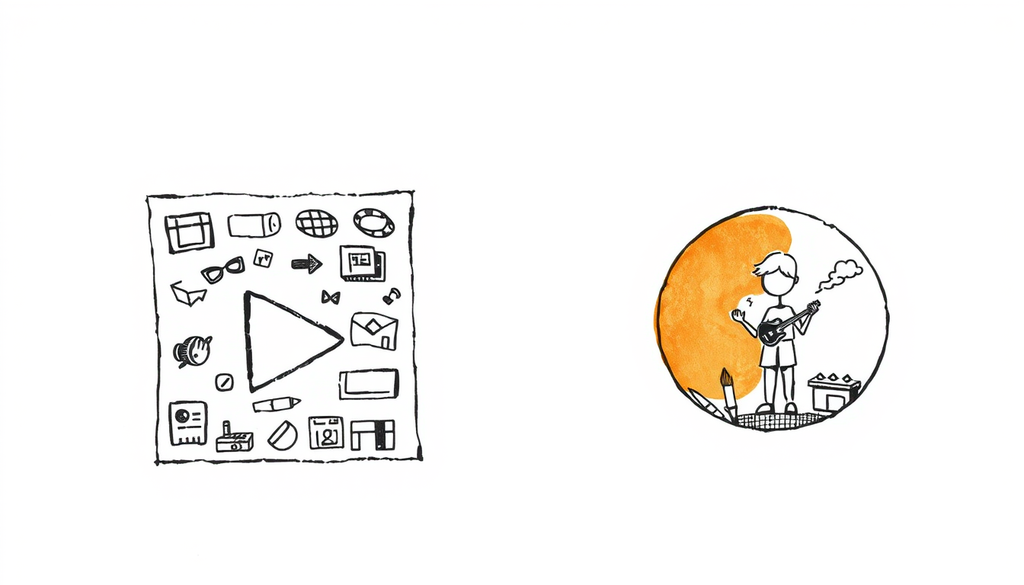
Most creatives position themselves around their output: the skills, formats and interests they care about. They don’t look at what people are actually searching for or asking about. What they miss is that audiences decide based on their own problems, not on your interests.
Businesses solve this with the Value Proposition Canvas, a tool developed by Strategyzer. In business school we use it to match a product to what customers actually need. When both sides line up, you have product-market fit. For a creator, you could call it personal brand–audience fit.
What is the Value Proposition Canvas?
The Value Proposition Canvas is a simple tool with two sides. On the right side is your audience. On the left side is what you offer them.
The audience side has three boxes:
- Jobs: what they’re trying to get done
- Pains: what frustrates them or blocks them
- Gains: what they hope for
Your side also has three boxes:
- Products & services: your content, lead magnet and future offers
- Pain relievers: how what you make takes away a pain
- Gain creators: how what you make helps them get a gain
The goal is fit: everything you make should connect to a real job, pain or gain.
Get this right and you don’t just get more leads and a bigger audience. You also get a clearer picture of what to make next. That doesn’t mean you have to talk about one thing forever, because your audience’s interests change too. But you give more value, and creating becomes more fun.
Filling in my own Value Proposition Canvas
Now let’s fill in my own canvas, so you can see what it looks like in practice.
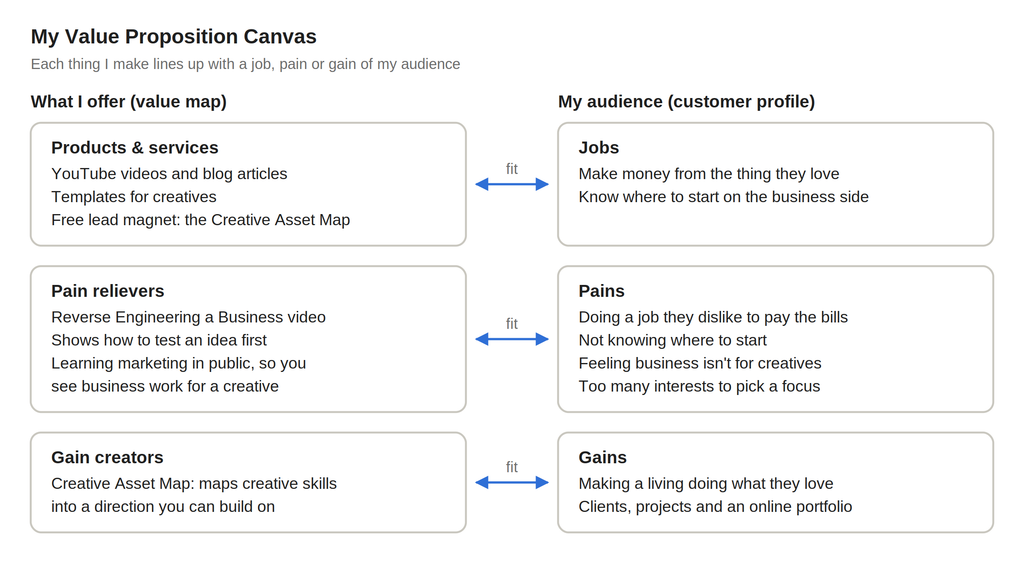
Jobs: what my audience wants to get done
My audience is multi-passionate creatives: musicians, photographers, writers, artists and other creative people. What they’re trying to do is simple. They want to make money from the thing they love doing, instead of keeping it as a side hobby. And they want to know where to start.
Pains: where they get stuck
They’re good at their craft, but they get stuck on the business side. A few pains I see again and again:
- They do a job they don’t like, just to put bread on the table.
- They don’t know where to start, so they don’t start at all.
- They feel like business “isn’t for creative people.”
- They have too many interests, so they can’t pick a focus.
Not everyone agrees with me on this, by the way. Someone once commented on one of my videos that all my talk about business, marketing and offers misses the point of creativity, and that I should spend that time creating instead.
I understand that feeling. For a long time I felt it myself. But it’s exactly the pain I’m talking about: the belief that business and creativity don’t belong together. That belief is what keeps a lot of creatives stuck in a job they don’t like.
Gains: what success looks like
Success for these people means making a living with the thing they love. Think of a photographer who makes content about photography, lands projects for customers and businesses, and has an online portfolio that brings in work.
A great example is my mother. The thing she loves most is painting, and she would love to do it all the time. But she doesn’t know how to build the business side around it. She’s exactly who I’m making this for.
My side: what I offer
I have an eye for creative things, but I’m interested in business too. I read a lot of business and marketing books, and I study Commercial Economics at Saxion. For a long time I asked myself if I should choose something creative instead. Then it clicked: the combination is my strength.
Here is how what I make maps to the audience side:
- Products & services: my YouTube videos, blog articles, templates and my free lead magnet, the Creative Asset Map.
- Pain reliever: Reverse Engineering a Business: Start With the Problem shows how to test an idea before you build it. That helps people who don’t know where to start.
- Gain creator: the Creative Asset Map helps you turn your creative skills into something you can actually build on.
The fit check
This is the honest part. My videos about mental health and mindfulness meant a lot to me. I struggled with those things myself and overcame obstacles.
But when I check them against the canvas, they don’t touch a job, pain or gain of my audience. That’s why they didn’t connect. The vague, philosophical videos were really for me, not for you.
The moment I got a clearer picture of who my audience was, it clicked. You never know exactly what people want from you at the start. You have to make things and look at the data.
How to fill in your own canvas today
Here are the steps to use the Value Proposition Canvas on your own personal brand:
- Draw the six boxes on a piece of paper.
- Fill in the audience side first: jobs, pains and gains.
- Use real comments, DMs and questions people ask you, instead of guessing.
- Then fill in your side: what you make, and which pain or gain it touches.
- Check every piece of content you’ve made against it.
Here is what that check looks like. Take one video or article you made and ask: which job, pain or gain does this help with? My Reverse Engineering a Business piece answers “I don’t know where to start,” so it fits. My mindfulness videos don’t answer any box, so they don’t.
Do this for your last five pieces of content and you’ll see a pattern fast.
One rule to remember: if a piece of content doesn’t touch a job, pain or gain, it’s for you, not your audience.
What I’m changing
Here is what I’m changing on my channel and blog: I’ll focus more on creatives and on what I’m learning in marketing. The skills I’m learning fit this field perfectly. I will still make art, music, sketches and photos, but now they are there to support the message and to connect with your passions.
Let me know your biggest pain in the comments below. And if you want to turn your creative skills into a clear direction, download the free Creative Asset Map.